1783350734608 800x500

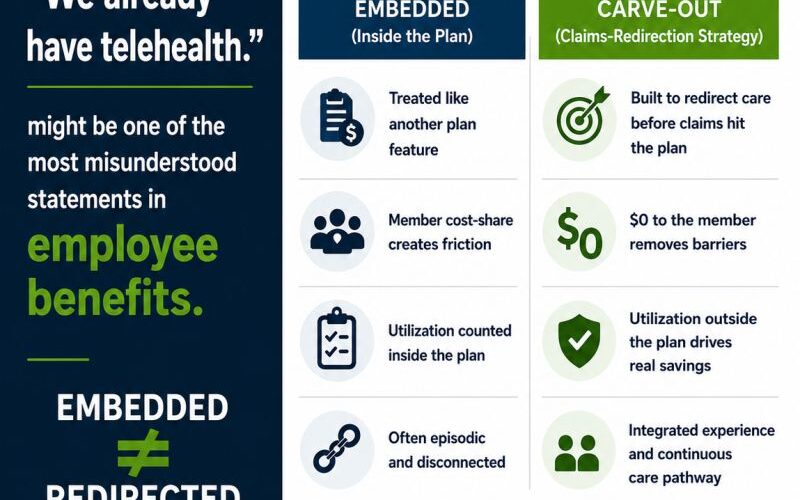
We already have telehealth” might be one of the most misunderstood statements in employee benefits.

We hear it all the time.

From brokers.
From TPAs.
From captives.
From self-funded groups.
From employers.

And I get why.

Most plans do have some version of telehealth built in.

But having telehealth buried inside the plan is not the same thing as having a real claims-redirection strategy.

That difference matters.

If telehealth is embedded in the medical plan, still tied to the traditional claims ecosystem, poorly communicated, and treated like just another plan feature, then the real question is:

What is it actually doing?

Is it replacing higher-cost care?

Is it redirecting unnecessary urgent care or ER visits?

Is it helping reduce pharmacy spend?

Is it giving members a cleaner front door before they generate avoidable claims?

Or is it just another benefit people technically “have,” but rarely use in a meaningful way?

RAND published research on commercially insured telehealth use that showed lower-cost virtual visits do not automatically equal lower total spend. In that study, many virtual visits appeared to be additional utilization rather than true replacement of office or ER visits.

To me, that does not mean telehealth is the problem.

It means the structure is the problem.

That is exactly why I believe these solutions often make more sense as strategic carve-outs.

A properly built carve-out gives the group a low fixed monthly cost, removes cost barriers for the member, and creates a clear pathway that can be actively promoted.

Virtual urgent care.
Virtual primary care.
Behavioral health.
Care navigation.
Second opinions.
Zero-dollar acute prescription formularies.
Chronic care support.
Preventive care.
Wellness visits.

When those services are carved out, integrated, and promoted correctly, the goal is not to suppress utilization.

It is the opposite.

You want members using that pathway.

Because when a member uses the carved-out pathway instead of creating an avoidable medical or pharmacy claim through the major medical plan, the economics change.

That is the point.

This is also where an integrated app matters.

A random one-off telehealth visit is helpful, but it can be episodic.

A connected virtual-care model is different.

When urgent care, primary care, behavioral health, navigation, prescriptions, referrals, and care notes can live inside a more coordinated experience, the member is not just getting a quick visit.

They are being directed into a better care pathway.

That is the lens I think more groups should use.

The question is not:

“Do we already have telehealth?”

The better question is:

“Is our virtual-care strategy actually changing where care happens, what claims hit the plan, and how members access care?”

Because “included” does not automatically mean “effective.”
1783009305316 800x500

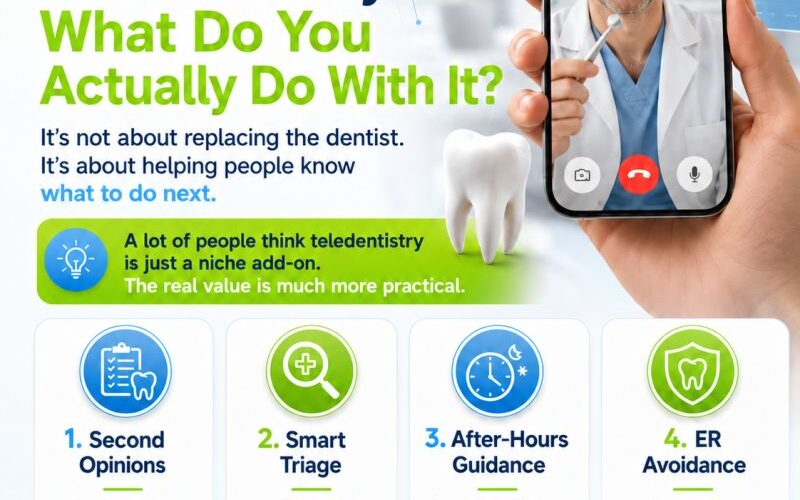
A question we hear a lot with teledentistry is:

“What do you actually do with it?”

Fair question.

A lot of people look at teledentistry as a niche product. A shiny little add-on. Something unique and different, but maybe not something with real practical value.

I think that misses the point.

Teledentistry is not meant to replace in-person dentistry.

It is not going to fill a cavity.
It is not going to pull a tooth.
It is not going to replace the work that has to be done in a dental chair.

That is not what it is for.

Where I think the value really shows up is in the real-world questions people actually have:

“Does my child really need all of their wisdom teeth pulled?”

“Do I really need two crowns right now?”

“Is this something that can wait, or do I need to get seen immediately?”

“Is this treatment plan reasonable, or should I get another opinion before I spend thousands of dollars?”

That second-opinion use case is where teledentistry starts to make a lot of sense.

Most people are not dental experts. When they are told they need major dental work, they often just have to trust what they are being told or start calling around trying to get another appointment somewhere else.

Having access to a virtual dentist gives them another place to start.

A second set of eyes.
A practical conversation.
Guidance from someone qualified to help them understand what they are being told.

The other major value is ER avoidance.

Dental issues do not always happen Monday through Friday from 8 to 5.

Sometimes it is late at night.
Sometimes it is a weekend.
Sometimes someone is traveling.
Sometimes the regular dentist is unavailable.

And sometimes the problem is real, but the solution may be simple: guidance, triage, an over-the-counter recommendation, or a prescription when clinically appropriate.

For employees, that means faster direction when they need help.

For employers and self-funded plans, it can mean fewer unnecessary emergency room visits for dental issues that may not have needed the ER in the first place.

That is the value of teledentistry.

Not replacing the dentist.

Helping people know what to do next.

1782908550699 800x500

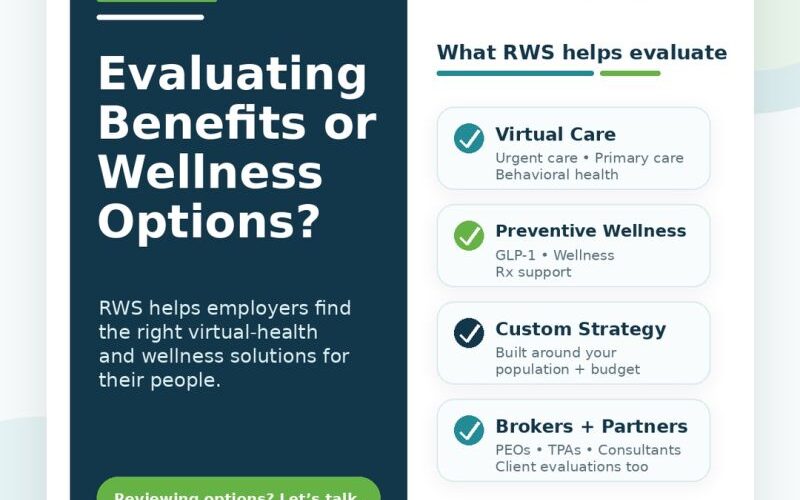
Is your organization evaluating benefits or wellness options?

Remote Wellness Solutions helps employers identify virtual-health and wellness solutions that are actually built around their people, their goals, and their budget.

Whether you are trying to improve access to care, add a stronger preventive wellness program, support employee retention, improve behavioral health access, or create a more complete benefits package, RWS can help simplify the process.

We can help evaluate and structure options for:

• Virtual urgent care
• Virtual primary care
• Behavioral health
• Prescription support
• Preventive wellness programs
• GLP-1 and medical weight-loss programs
• Dental, vision, telehealth, and supplemental benefit solutions
• Custom benefit bundles for employees or members

The goal is simple: help your organization sort through the noise, identify the right options, and build a benefits strategy that makes sense for the population you serve.

And if you are a broker, consultant, PEO, TPA, association, or group benefits advisor evaluating solutions for your clients or members, we can help you too.

If benefits are on your radar right now, this is a good time to have the conversation.

Remote Wellness Solutions
Virtual-health and wellness solutions built around your population.

1782310634194 800x500

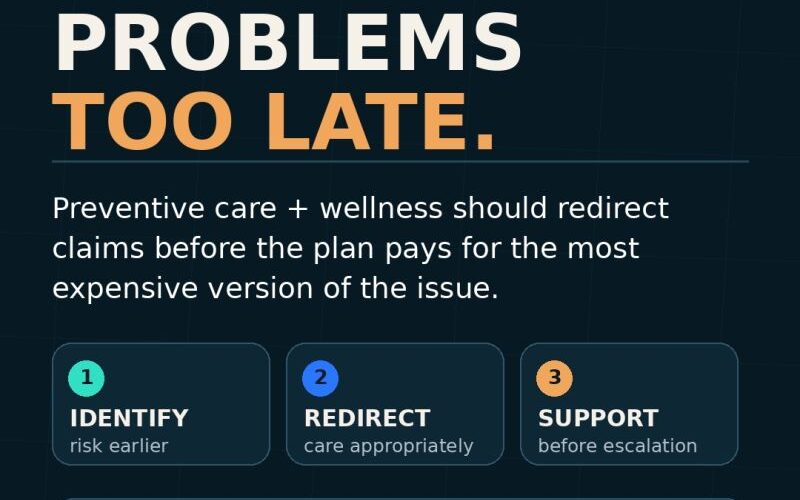
Preventive care and wellness programs should be judged by one thing:

Do they help move members to the right care earlier?

That’s how we look at it at RWS.

If someone uses virtual urgent care for a non-emergency issue instead of going through a higher-cost setting tied to the major medical plan, that can matter.

If virtual primary care helps catch blood pressure issues, A1C concerns, medication problems, obesity risk, depression, anxiety, or other concerns earlier, that can matter too.

No program prevents every claim. Nobody serious should promise that.

But the right program can help redirect care, surface risk earlier, and give members a cleaner path before small problems become large, expensive problems.

That is especially relevant when KFF reports the average employer-sponsored family premium reached $26,993 in 2025, and the CDC reports that 90% of the nation’s $5.3 trillion in annual healthcare spending is tied to chronic and mental health conditions.

At RWS, we care less about how many benefits are listed on a flyer and more about what happens when a member actually uses the program.

Does it help them get care sooner?

Does it help the plan avoid unnecessary claims when a lower-cost, appropriate access point exists?

Does it support prevention, primary care, behavioral health, prescriptions, screenings, and navigation in a way that makes sense?

That’s the conversation we want to have with employers, brokers, consultants, TPAs, PEOs, associations, affinity groups, and PCMP/wellness program operators.

Not “how many things can we bundle?”

More like:

What problem are we trying to solve?

What care access is missing?

Where are costs being driven?

Where can we redirect members before the plan pays for the most expensive version of the issue?

That’s where preventive care and wellness can become more than a benefit line item.