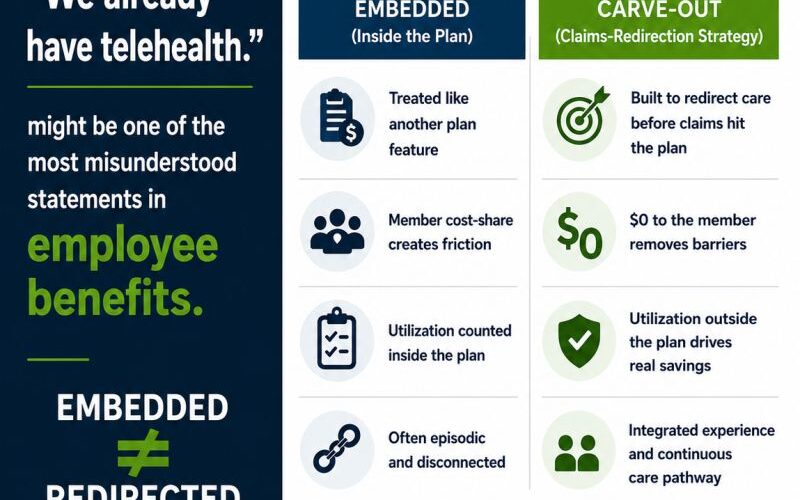
We already have telehealth” might be one of the most misunderstood statements in employee benefits.

We hear it all the time.
From brokers.
From TPAs.
From captives.
From self-funded groups.
From employers.
And I get why.
Most plans do have some version of telehealth built in.
But having telehealth buried inside the plan is not the same thing as having a real claims-redirection strategy.
That difference matters.
If telehealth is embedded in the medical plan, still tied to the traditional claims ecosystem, poorly communicated, and treated like just another plan feature, then the real question is:
What is it actually doing?
Is it replacing higher-cost care?
Is it redirecting unnecessary urgent care or ER visits?
Is it helping reduce pharmacy spend?
Is it giving members a cleaner front door before they generate avoidable claims?
Or is it just another benefit people technically “have,” but rarely use in a meaningful way?
RAND published research on commercially insured telehealth use that showed lower-cost virtual visits do not automatically equal lower total spend. In that study, many virtual visits appeared to be additional utilization rather than true replacement of office or ER visits.
To me, that does not mean telehealth is the problem.
It means the structure is the problem.
That is exactly why I believe these solutions often make more sense as strategic carve-outs.
A properly built carve-out gives the group a low fixed monthly cost, removes cost barriers for the member, and creates a clear pathway that can be actively promoted.
Virtual urgent care.
Virtual primary care.
Behavioral health.
Care navigation.
Second opinions.
Zero-dollar acute prescription formularies.
Chronic care support.
Preventive care.
Wellness visits.
When those services are carved out, integrated, and promoted correctly, the goal is not to suppress utilization.
It is the opposite.
You want members using that pathway.
Because when a member uses the carved-out pathway instead of creating an avoidable medical or pharmacy claim through the major medical plan, the economics change.
That is the point.
This is also where an integrated app matters.
A random one-off telehealth visit is helpful, but it can be episodic.
A connected virtual-care model is different.
When urgent care, primary care, behavioral health, navigation, prescriptions, referrals, and care notes can live inside a more coordinated experience, the member is not just getting a quick visit.
They are being directed into a better care pathway.
That is the lens I think more groups should use.
The question is not:
“Do we already have telehealth?”
The better question is:
“Is our virtual-care strategy actually changing where care happens, what claims hit the plan, and how members access care?”
Because “included” does not automatically mean “effective.”