
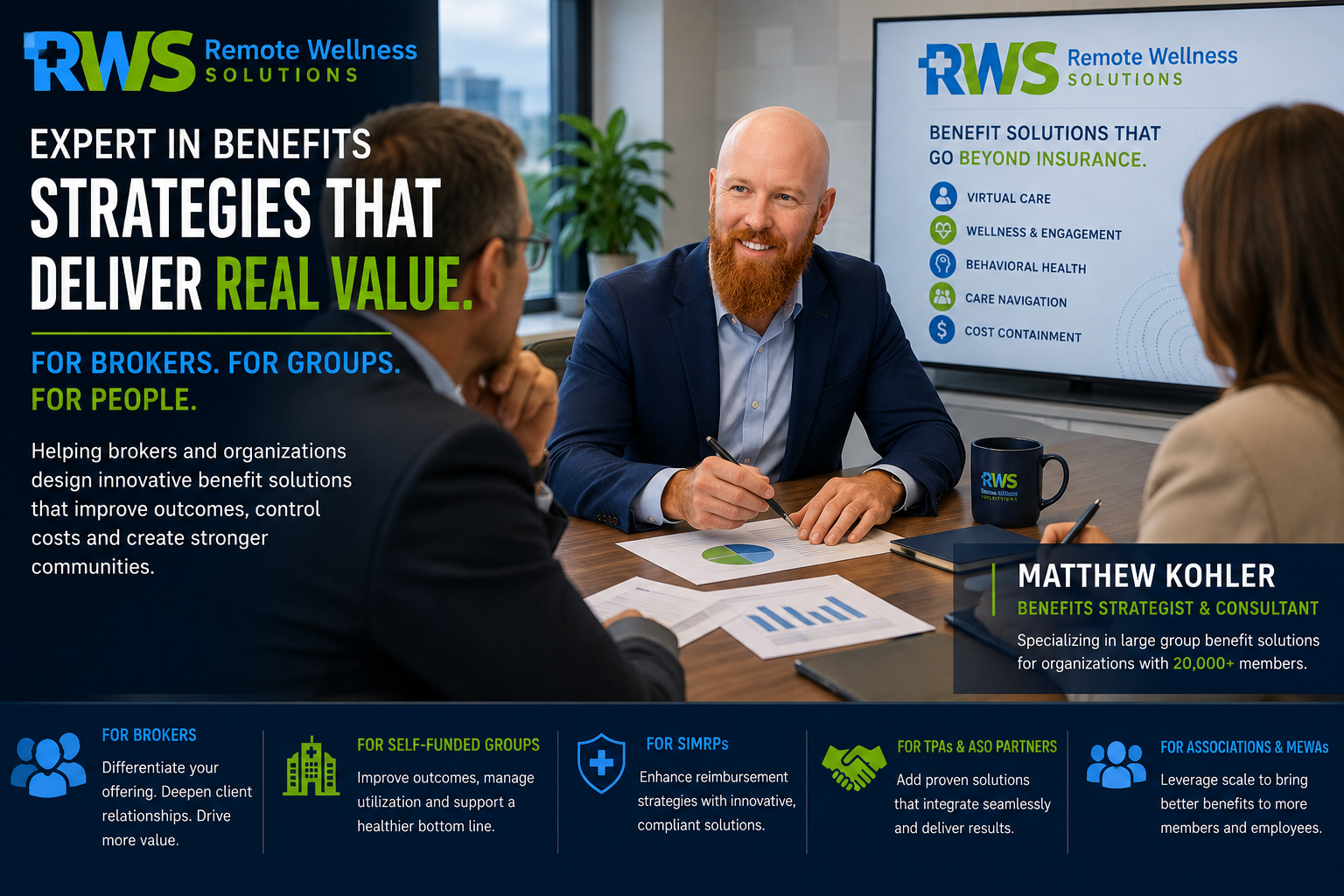
Expert in Benefits for Brokers, Self-Funded Groups & SIMRPs: Matthew Kohler
The employee benefits market is changing rapidly, and insurance brokers are increasingly being asked to deliver more than traditional insurance products.
Employers want better access to care. They want stronger employee engagement. They want wellness solutions, cost-containment strategies, behavioral health resources and benefits their employees will actually use.
For brokers, that creates both a challenge and an enormous opportunity.
Matthew Kohler specializes in helping insurance brokers, self-funded groups, SIMRPs and large membership organizations identify and implement innovative benefit solutions that complement existing insurance programs.
His particular area of focus is large groups with populations of 20,000 or more members, employees or eligible participants.
Rather than competing with the insurance broker, Kohler’s approach is built around making the broker’s offering stronger.
Benefits for Insurance Brokers: Going Beyond Traditional Insurance
Insurance brokers have traditionally built benefits packages around products such as medical, dental, vision, life and disability insurance.
Those products remain important.
But employers increasingly expect their broker to help solve a much broader range of problems.
How can employees get easier access to healthcare?
How can an organization improve utilization?
What wellness resources can be provided?
How can behavioral health access be improved?
What programs can help employees navigate an increasingly complicated healthcare system?
And perhaps most importantly:
What can a broker bring to the table that another broker isn’t already offering?
This is where Kohler focuses much of his work.
The objective is to identify non-insurance and supplemental benefit solutions that can work alongside an organization’s existing benefits structure.
Helping Insurance Brokers Become More Valuable
There is a major strategic advantage for brokers who expand beyond simply quoting insurance.
Consider two brokers competing for the same large employer.
One brings the employer its annual medical renewal.
The other brings the renewal along with virtual healthcare, wellness programs, behavioral health resources, prescription solutions, care navigation and other benefits designed around the needs of that employer.
The second broker is having an entirely different conversation.
Instead of simply being an insurance salesperson, the broker becomes a benefits strategist.
And the more valuable solutions a broker brings into an organization, the deeper that client relationship can become.
That’s why Kohler’s approach isn’t about replacing brokers.
It’s about helping brokers become harder to replace.
Matthew Kohler’s Specialization in 20,000+ Member Groups
One of the defining characteristics of Kohler’s work is his focus on large populations.
He specializes in groups representing 20,000+ members, including large employers, self-funded organizations, associations, benefit arrangements and other large membership populations.
Scale matters.
A benefit solution deployed across 200 employees can certainly create value.
But when that same type of solution is evaluated across 20,000, 50,000 or 100,000+ eligible participants, the economics can change dramatically.
Large populations can create greater negotiating leverage, broader implementation opportunities and the ability to structure programs specifically around the needs of the organization.
Kohler’s focus is therefore not simply:
“What benefit can we sell?”
It’s:
“What solutions make sense for this population, and how can we use the group’s scale to create greater value?”
Benefits for Self-Funded Groups
Self-funded groups represent an especially important opportunity.
With a self-funded health plan, the employer generally assumes responsibility for funding covered healthcare claims rather than transferring all of that financial risk to a traditional insurance carrier.
Because the employer has direct financial exposure to healthcare utilization, benefits that can potentially improve access, navigation, engagement or appropriate utilization can become particularly important.
This creates opportunities to evaluate solutions such as:
- Virtual healthcare and virtual primary care
- Wellness and employee engagement programs
- Behavioral and mental health resources
- Prescription savings programs
- Care navigation and health advocacy
- Supplemental non-insurance benefits
The right solution depends on the group.
The goal isn’t simply to add more benefits.
It’s to add the right benefits.
SIMRPs: Self-Insured Medical Reimbursement Plans
Another area of specialization is SIMRPs — Self-Insured Medical Reimbursement Plans.
SIMRPs are employer-sponsored medical reimbursement arrangements. Programs marketed under the SIMRP model commonly incorporate medical reimbursement, wellness or preventive-care components and are often structured with reference to Sections 105 and 125 of the Internal Revenue Code.
These arrangements are distinct from traditional health insurance and should be structured and administered carefully with appropriate legal, tax and benefits guidance.
For brokers, SIMRPs represent another example of why understanding the broader benefits ecosystem has become increasingly important.
An employer may already have its underlying health coverage in place.
The opportunity is then to determine what additional structures and programs can complement that coverage and provide additional value to the organization and its employees.
Working With TPAs and ASO Arrangements
Large self-funded organizations frequently work with TPAs — Third-Party Administrators — to administer various aspects of their benefit plans.
Organizations may also operate through ASO — Administrative Services Only — arrangements, where administrative services are provided while the employer retains the underlying claims risk.
These relationships are important because introducing a new benefit into a large population isn’t simply about choosing a product.
There are operational considerations.
Eligibility.
Enrollment.
Administration.
Data.
Billing.
Employee communication.
Utilization.
Reporting.
Integration with existing programs.
For a population of 20,000+ people, those details matter.
Kohler’s large-group focus therefore involves understanding not only what benefit might work, but also how that benefit fits within the organization’s existing benefits ecosystem.
MEWAs and Multi-Employer Benefit Opportunities
Kohler’s work can also intersect with MEWAs — Multiple Employer Welfare Arrangements.
Under federal law, a MEWA generally involves an arrangement established or maintained to provide welfare benefits to employees of two or more employers, subject to specific statutory exceptions and regulatory requirements.
These arrangements can create particularly interesting opportunities because multiple employers may participate within a larger benefits structure.
However, MEWAs also involve important federal and state regulatory considerations.
The benefit strategy therefore needs to account for the specific structure of the arrangement rather than treating every large population identically.
Level-Funded Groups
Level-funded arrangements represent another segment of the benefits marketplace.
These programs generally combine characteristics of self-funding with predictable monthly payments and stop-loss protection.
For brokers serving these employers, supplemental and non-insurance benefits can provide another opportunity to differentiate the overall offering.
Again, Kohler’s philosophy remains the same:
Don’t replace something simply because you can. Identify what’s missing and improve the overall package.
Associations and Large Membership Organizations
Large-group benefit opportunities aren’t limited to traditional employers.
Associations and membership organizations can collectively represent enormous populations.
An association might have hundreds or thousands of member businesses.
Those businesses could collectively represent tens of thousands of employees.
That aggregation can create something extremely valuable:
scale.
Instead of approaching each small employer individually, certain benefits can potentially be structured or negotiated around a much larger population.
This can give brokers, associations and benefit consultants opportunities to introduce solutions that might otherwise be difficult for smaller organizations to access independently.
The Non-Insurance Benefits Opportunity
The term non-insurance benefits covers a broad range of potential solutions.
Depending on the employer or membership population, these might include:
Virtual Healthcare — expanding access to physicians and other healthcare professionals without requiring every interaction to occur in a traditional office.
Wellness Programs — helping organizations encourage healthier behaviors, engagement and preventive care.
Behavioral Health — providing employees with greater access to mental and behavioral health resources.
Prescription Programs — helping employees navigate prescription costs and available savings opportunities.
Care Navigation — helping members better understand and navigate healthcare options.
Supplemental Benefits — adding services that increase the overall value of an organization’s benefits package.
Not every organization needs every solution.
That’s precisely the point.
The strategy should be built around the organization rather than forcing the organization around a predetermined product.
Building a Benefits Ecosystem
Kohler believes the future of benefits consulting will increasingly involve creating a benefits ecosystem rather than simply assembling a list of products.
The conversation begins with understanding what the organization already has.
Then asking:
What’s missing?
Where are employees struggling?
Where is the employer spending unnecessarily?
Which benefits are actually being utilized?
What could the broker introduce that creates measurable additional value?
How can the group’s size improve the economics?
For large groups, those questions can reveal opportunities that aren’t obvious when benefits are evaluated one product at a time.
More Than Insurance. More Value.
Traditional insurance isn’t going anywhere.
Nor should it.
But the benefits package of the future can be much larger than insurance alone.
The broker who understands this has an opportunity to become considerably more valuable to clients.
Instead of simply delivering policies, the broker can deliver an ecosystem of solutions.
Instead of discussing benefits once a year during renewal, the broker can become involved throughout the year.
Instead of competing primarily on insurance pricing, the broker can compete on value, strategy and innovation.
That’s where Matthew Kohler has chosen to specialize.
Matthew Kohler: Expert in Benefits for Brokers, Self-Funded Groups & SIMRPs
Matthew Kohler focuses on helping insurance brokers, self-funded groups, SIMRPs, MEWAs, TPAs, ASO arrangements, level-funded groups, associations and large membership organizations evaluate benefit opportunities beyond traditional insurance.
His specialty is particularly focused on groups with 20,000+ members, where scale can create significant opportunities for innovative benefit strategies.
The objective isn’t adding benefits simply for the sake of having more benefits.
It’s finding solutions that:
increase value,
improve the employee or member experience,
strengthen the broker-client relationship,
complement the existing benefits structure,
and ultimately create a stronger overall benefits ecosystem.
For insurance brokers, that represents an important opportunity.
Bring more to the client.
Create more value.
Build a deeper relationship.
Become the broker your clients can’t easily replace.

No comment