
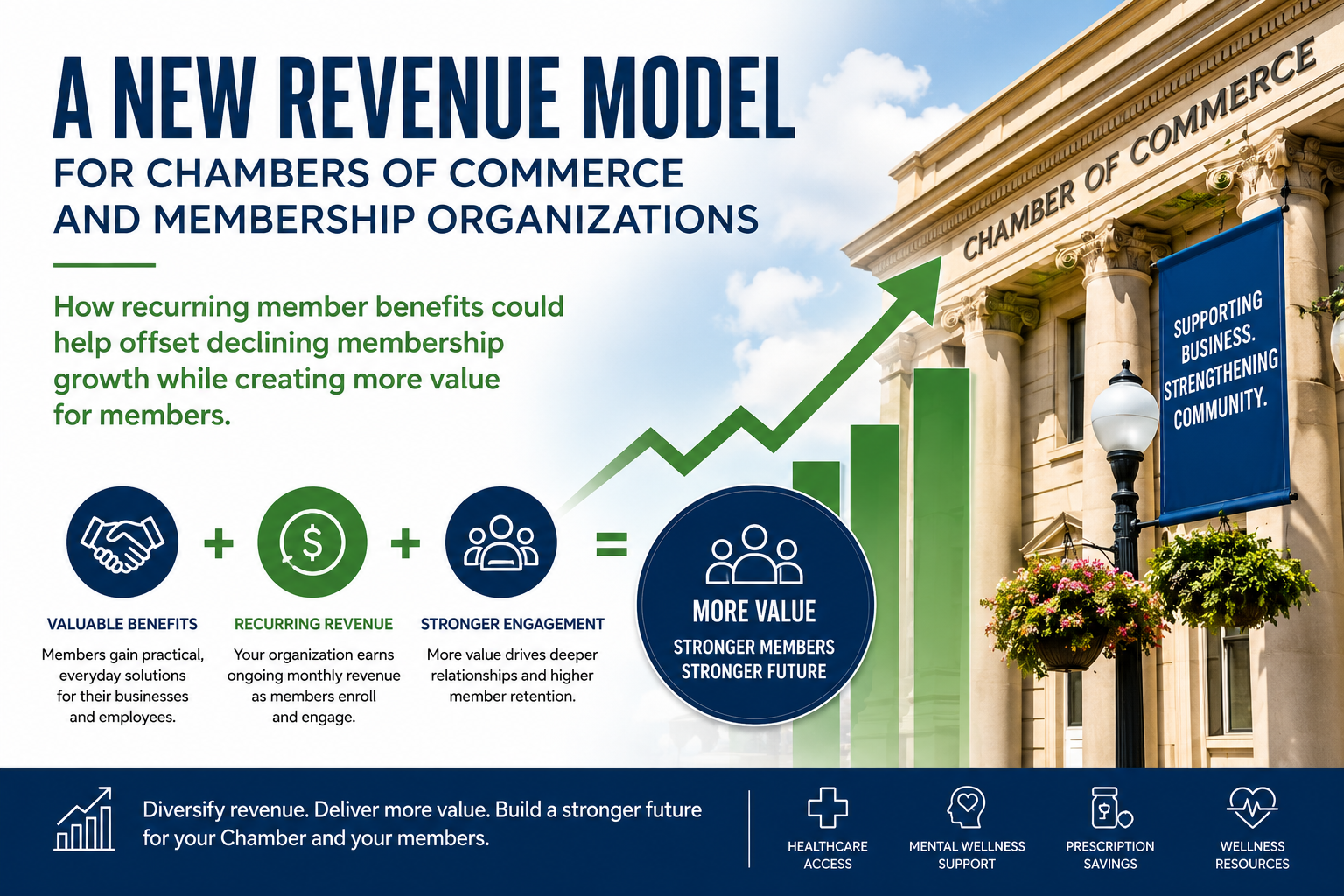
A New Revenue Model for Chambers of Commerce and Membership Organizations
How recurring member benefits could help organizations strengthen revenue while delivering greater value to members.
For generations, Chambers of Commerce and membership organizations have served as the backbone of their local business communities. They connect business leaders, advocate for economic growth, provide educational opportunities, and create valuable networking relationships.
That mission hasn’t changed.
What has changed is the business environment surrounding it.
According to the American Society of Association Executives (ASAE), “Association membership has been flat or declining for nearly a decade,” citing Marketing General’s Membership Marketing Benchmarking Reports. As organizations compete for members’ attention while operating costs continue to rise, many are being forced to rethink how they generate revenue and demonstrate value.
Membership dues alone may no longer be enough to support long-term growth.
The Traditional Model Is Being Challenged
For decades, the formula has remained largely the same.
Recruit new members.
Retain existing members.
Collect annual dues.
Generate additional income through sponsorships, events, advertising, and educational programs.
These revenue sources continue to play an important role, but they also require significant time, planning, and ongoing effort. Every year, organizations essentially start over—working to renew memberships, secure sponsors, and fill event registrations.
There is nothing wrong with this model.
The question is whether there are additional revenue opportunities that can complement it.
Members Expect More Than Networking
Businesses today expect membership organizations to provide more than networking events and advocacy.
They are looking for practical resources that help them operate their businesses, support their employees, and reduce expenses.
Organizations that consistently introduce meaningful benefits often strengthen member engagement while creating additional reasons for businesses to join—and renew.
That shift opens the door to a different way of thinking about membership value.
From Annual Dues to Recurring Revenue
Imagine a Chamber of Commerce introducing a voluntary virtual healthcare and wellness benefit to its member companies.
The Chamber does not build the program.
It does not hire staff to manage it.
It does not provide customer service.
Instead, a trusted partner develops and manages the entire program—including vendor relationships, implementation, enrollment support, customer service, and ongoing administration.
The Chamber simply introduces the opportunity to its members.
When employees voluntarily enroll, the organization earns recurring monthly revenue.
Rather than relying exclusively on annual membership renewals, the Chamber creates an additional revenue stream that grows alongside member participation.
Membership Dues Will Always Matter
Membership dues remain the financial foundation of most Chambers and associations.
Depending on the organization and membership level, businesses often invest anywhere from a few hundred dollars to well over one thousand dollars each year to belong.
That revenue is essential.
However, it is also limited. Once a membership is sold, the organization generally doesn’t generate additional revenue from that business until the following renewal cycle.
Recurring revenue models operate differently.
Instead of depending entirely on annual renewals, organizations can generate ongoing monthly income from voluntary member participation in programs that provide real, everyday value.
This creates a more diversified financial model without increasing membership dues.
Creating Value Instead of Simply Selling Memberships
Perhaps the biggest advantage of this approach isn’t the recurring revenue.
It’s the additional value provided to members.
Small and medium-sized businesses are constantly looking for affordable ways to improve employee benefits while managing costs.
Programs such as virtual primary care, urgent care, behavioral health services, wellness resources, and prescription savings can provide meaningful value to employers and their employees without requiring the Chamber to become a healthcare provider or benefits administrator.
The Chamber becomes the organization that connected its members with a valuable resource.
That creates another reason for businesses to remain engaged and continue their membership.
The Future May Be Built on Partnerships
Membership organizations have always evolved alongside the needs of their communities.
Today’s challenges don’t necessarily call for abandoning the traditional membership model—they call for expanding it.
Strategic partnerships that create recurring, non-dues revenue while delivering meaningful member benefits may become an increasingly important part of the next generation of Chambers of Commerce and business associations.
The organizations that thrive over the next decade may be those that continually ask a simple question:
How can we create more value for our members while building a stronger, more sustainable organization?
For many Chambers and membership organizations, the answer may not be found in increasing membership dues.
It may be found in creating entirely new ways to serve the businesses that already trust them.
No comment